Introduction: The Frustrating Standstill in a Decades-Old Fight
For decades, the fight against osteosarcoma, a type of bone cancer, has been at a standstill. While chemotherapy has been a cornerstone of treatment, the standard regimens have not changed in years. Patients endure highly toxic treatments that cause significant short- and long-term side effects, all while researchers have struggled to find better, safer alternatives. As the researchers behind a new study note, this isn’t for a lack of effort:
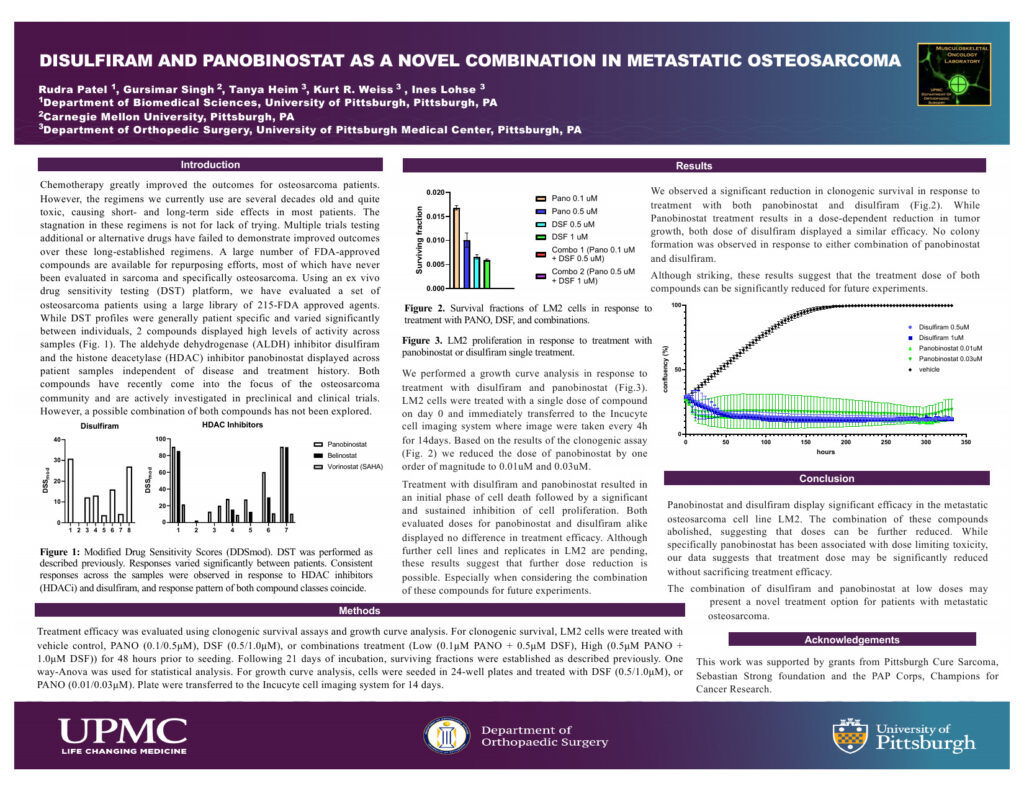
Chemotherapy significantly improved outcomes in patients with osteosarcoma. However, the regimens we currently use are several decades old and quite toxic, causing short- and long-term side effects in most patients. The stagnation in these regimens is not due to a lack of effort.
Multiple clinical trials testing new drugs have failed to improve outcomes, leaving patients and doctors in a frustrating holding pattern. But what if the answer wasn’t a brand-new drug, but a novel combination of existing ones?
Finding Needles in a Haystack by Searching the Pharmacy Shelf
Instead of starting from scratch to develop a new drug—a process that can take years—researchers took a clever shortcut. They screened an extensive library of 215 FDA-approved compounds to determine whether any could be repurposed to treat osteosarcoma. This ex vivo drug sensitivity testing on patient samples revealed two standout compounds that were consistently effective: disulfiram, an aldehyde dehydrogenase (ALDH) inhibitor, and Panobinostat, a histone deacetylase (HDAC) inhibitor.
These weren’t entirely random discoveries; both drugs have recently been of interest to osteosarcoma researchers, but this study was the first to explore their potential in combination. This “drug repurposing” approach is powerful because it leverages drugs with known safety profiles, potentially accelerating the path from the laboratory to new patient treatments.
Synergy in Action: A Combination That Stops Cancer Colonies Cold
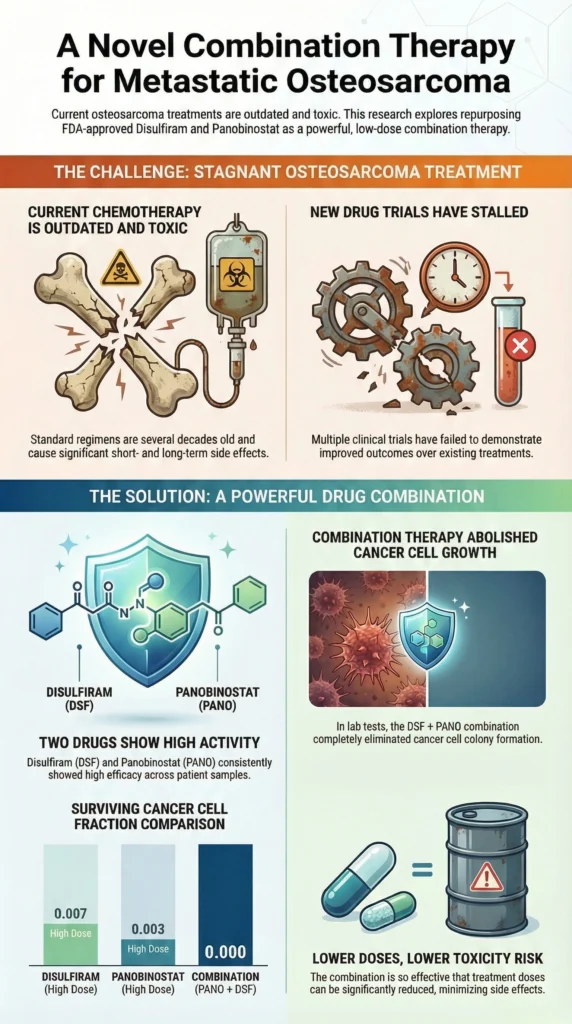
The most striking result of the study emerged when researchers combined the two drugs and tested them on a well-characterized metastatic osteosarcoma cell line, LM2. The effect was dramatic. While each drug showed some ability to reduce tumor growth on its own, the combination treatment completely stopped the cancer cells from forming new colonies (a key indicator of a cancer’s ability to grow and multiply aggressively).
This robust finding is stated unequivocally in the research:
No colony formation was observed in response to either combination of Panobinostat and disulfiram.
This result suggests a powerful synergistic effect, whereby the two drugs, when used together, are far more effective at inhibiting cancer proliferation than either drug alone.
The “Less is More” Promise: Reducing Toxicity Without Losing Power
Beyond its sheer power against cancer cells, the combination therapy addresses the other major challenge laid out from the start: the severe toxicity of current treatments. Because the combo was so potent, the researchers believe the doses of both drugs could be lowered significantly while still achieving the same cancer-fighting effect. This is critical because Panobinostat, in particular, has been associated with “dose-limiting toxicity.”
The researchers were so encouraged by the initial combination’s potency that they reduced the Panobinostat dose by a factor of 10 in subsequent experiments and still observed a significant growth-inhibiting effect, underscoring the potential for a lower-toxicity treatment. They highlight this potential breakthrough:
…our data suggest that the treatment dose may be significantly reduced without compromising treatment efficacy.
This offers the hope of a future treatment that is not only more effective against a hard-to-treat cancer but is also gentler on the very patients it aims to save.
Conclusion: A New Chapter for a Hard-to-Treat Cancer?
The discovery that a combination of disulfiram and Panobinostat can abolish the colony-forming ability of metastatic osteosarcoma cells in vitro suggests a novel and highly promising therapeutic strategy. This research, from a collaboration including the University of Pittsburgh Medical Center (UPMC) and the University of Pittsburgh, provides a much-needed ray of hope in a field that has seen little progress for decades.
It also raises an exciting question for the future of medicine: Could more combinations like this be hiding in plain sight, ready to break the stalemate for other challenging diseases?